I love potstickers. Actually, I love all kinds of dumplings, steamed buns, and pretty much anything that is a savory filling in dough. I like making these things, too--there's something great about the process of making the dough and the filling, and shaping the potstickers, steamed buns, pies, etc. It usually takes a few hours for everything to come together, but the resulting food is usually enough to eat several times. Every few months, I set aside a half a day or so for the process; the previous time (a few weeks ago), I made kimchi-filled steamed buns--we liked them so much, there was barely any left over after dinner. I'd never made steamed buns before, and mine were far from pretty, but they were so good! I also like that I could make the dough for them myself, whereas with potstickers, there's just no way that I'm willing to roll out quite so many perfect circles of dough.
Yesterday, Matt and I worked on potstickers with three different fillings--one was tofu and green onion; another had king oyster mushrooms and buna-shimeji; and the third was a mix of mushrooms, napa cabbage, and green onions. We'd gotten the vegetables on Saturday in our CSA share, and although I had wanted to make kimchi, I realized that we still have some left from our last batch; the potstickers took more effort, but I'm glad that we've made them. We also made a batch of the steamed buns with a couple of the different fillings, and put everything away into the freezer for later.
I like doing this--putting away food for later; it's probably why I became so enthusiastic about canning so quickly. And canning paved the way for making more things like this... Not only can I make things that taste so much better than what I can get at the Asian market, but I can also use up the local ingredients that we get from our CSA basket.
Showing posts with label patience. Show all posts
Monday, May 23, 2011
Saturday, March 12, 2011
Reduce, Re-use
Three years into being a vegan, veganism is normative to me; it's not necessarily always easy (I still have to ask questions every time I eat at an unfamiliar restaurant, and I continue to meet people to whom I explain veganism), but it is what is normal. There are definitely some things that I could still continue to figure out--in terms of cooking, or buying, or what-not, but for the most part, I don't spend as much time just contemplating veganism. And I think that I miss that, a little. I like thinking about the importance of daily objects, and how the domestic is the political. I know that making ethically-informed purchases is important--whether it's shampoo or food. And partially as an extension of my canning endeavors--which have shifted our dependence onto a different, and often local producer of ingredients, I've started thinking about other things in slightly different terms. Now that veganism is normative, I want to see if there are other areas in my life that I can change for the better.
Part of the change that I'm envisioning is a more radical reduction in my production of trash. I'm not sure how much I can reduce our output of trash, but I'm starting to try. I try to ask for ceramic mugs at coffee shops, where the baristas often automatically reach for the paper cups. I'm going to start trying to take more of my bulk containers to the co-op when I'm buying bulk items. I recently made lotion again, and am storing it in a mason jar. As of tomorrow, I will be out of shampoo, and I'm not buying any more; for that matter, I'm never buying body wash or face wash again, and am using castille soap and baking soda for cleaning not just myself, but just about everything. I know that a lot of the things that I'm not going to be buying anymore come in recyclable containers, but many of these containers are plastics that get down-cycled instead of recycled. Too often, we forget that reducing and reusing come before recycling. Reducing and reusing is more difficult than recycling, too, in that both force us to re-examine our methods of consumption, rather than just adding a step to our methods of disposal. Reducing, or doing without some things ultimately makes a bigger difference.
The main questions that I've been trying to ask of things are 1) Do I need this at all? and 2) Can I make (cook, can, or grow) it myself? I know that I can't make essential oils or baking soda or castille soap, but I know that buying those things means a much greater reduction in the number of cleaning agents that I buy. I hope that I can keep up with this, along with my resolve to not buy new clothes this year, and I'll try to note the kind of difference that it makes, before this, too--I hope--becomes natural and normative.
Part of the change that I'm envisioning is a more radical reduction in my production of trash. I'm not sure how much I can reduce our output of trash, but I'm starting to try. I try to ask for ceramic mugs at coffee shops, where the baristas often automatically reach for the paper cups. I'm going to start trying to take more of my bulk containers to the co-op when I'm buying bulk items. I recently made lotion again, and am storing it in a mason jar. As of tomorrow, I will be out of shampoo, and I'm not buying any more; for that matter, I'm never buying body wash or face wash again, and am using castille soap and baking soda for cleaning not just myself, but just about everything. I know that a lot of the things that I'm not going to be buying anymore come in recyclable containers, but many of these containers are plastics that get down-cycled instead of recycled. Too often, we forget that reducing and reusing come before recycling. Reducing and reusing is more difficult than recycling, too, in that both force us to re-examine our methods of consumption, rather than just adding a step to our methods of disposal. Reducing, or doing without some things ultimately makes a bigger difference.
The main questions that I've been trying to ask of things are 1) Do I need this at all? and 2) Can I make (cook, can, or grow) it myself? I know that I can't make essential oils or baking soda or castille soap, but I know that buying those things means a much greater reduction in the number of cleaning agents that I buy. I hope that I can keep up with this, along with my resolve to not buy new clothes this year, and I'll try to note the kind of difference that it makes, before this, too--I hope--becomes natural and normative.
Thursday, March 3, 2011
Kombucha
I first heard about kombucha a few years ago, when I was eating raw for a week while Matt was away at Louisville, and I decided to try it, despite its price. I can't say that I loved it immediately, but there was something intriguing about the taste, and it reminded me of kvass--something that I used to drink during my childhood in the former USSR. So I kept coming back to it, buying it occasionally, as a little boost for a crummy day, or just because. On one of these casual acquisitions, a cashier at Whole Foods turned to me, just as I was leaving, and said, "You know, you can make this stuff yourself. It's not that hard."
I, of course, took that as a challenge, and became determined to make my own kombucha. I started reading about it, obsessing about it, looking up reputable dealers of the mother culture...and actually didn't do anything about it for over a year. I kept telling myself that I didn't have enough time to tend to kombucha, that I would somehow ruin it and let it mold, that I wasn't a fit parent. And then what?
Jars came along. I've written a little bit about how canning has changed the way I look at food; but it's not just about canning. Jars have changed the way I look at food. We buy more bulk items because I love storing them in jars. And once I acquired a few half-gallon jars, I just had to put them to use. One of them holds the granola that I make almost weekly, a few of them hold the mellowing liquors, and one of them is a dedicated kombucha jar. It wasn't until I had the proper vessel that I decided to brave the kombucha-making experience.
To grow the beautiful mother that you see, I bought a bottle of kombucha, dumped it into a sterilized half-gallon jar, and added two cups of strong black tea sweetened with a half-cup of sugar. Because I started the growing in the winter, it took about a month for the liquid to form a thin, but cohesive film layer. I added a few tablespoons of sugar every few weeks, to feed the baby culture, and two months later, I had a mother culture that was barely over an eighth of an inch thick, floating smugly atop the vinegary-smelling tea ferment. I may have rushed things a bit, but at that point, I started the production of kombucha--I poured off about 3/4 of the finished kombucha, then brewed about 6 cups of tea, sweetened it with half a cup of sugar (waited until it was at room temperature), and added it to the jar. And thus, every week for a couple months, now. I've even flavored small batches of kombucha with ginger-syrup! I'm glad that I gave it a try. If you would like, ask me in a couple months (when the mother culture is stronger yet,) and I can share a little baby SCOBY with you, too.
Monday, February 7, 2011
Starting from Seed
Until last September, I viewed seeds as a type of magic, or novelty, or a little of both--they were something that others could bring to life, but not I. They were things that had too many requirements to bother with, and I was never patient enough with them to see the return on my efforts. And then, I planted some collard seeds, and by November, there was enough for us to have as a side for a meal. And those collards have actually survived the winter, battling the slugs, the cold, and my neglect--and in a few weeks, there'll be enough to eat, again. So I'm glad to finally give starting from seed a chance.
Yesterday, there was an exchange of seeds at The Birdhouse, and it was so good to be around people who were as excited about seeds as I was--although I understand, mine is a newcomer's joy. I was glad to see so many people with so much faith in seeds (their magic, their life)! The picture above is the first Sturon onion seedling; since then, I've had four more sprout. I keep them close-by, on my work-table, and watch as they unfold their spindly little greens. There is nothing more beautiful to me now. Last night, when I was trying to fall asleep and could not, I imagined that I was a restless little seed, waiting for spring.
Labels:
growing,
patience,
seeds,
The Birdhouse,
urban land scouts
Friday, February 4, 2011
Liqueurs, Continued: Home-Made Orange Liqueur (or Triple Sec)
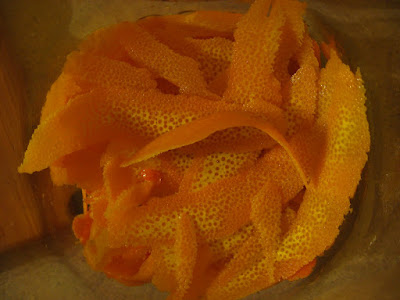
After beginning the process for limoncello (and a small batch of lime-oncello), I kept coming back to the idea of an orange liqueur--something like triple sec, but less sweet, and with a stronger orange flavor. I also wanted it to be less potent than the limoncello, which will be about 40% alcohol when it's finished. And after looking up a few recipes for home-made triple sec, I was ready to try it. I do want to say that I changed the proportions of the recipes that I looked at, as they had in mind something all too sweet and syrupy. I imagine my orange liqueur retaining some of the bitterness of citrus, and some of the complexity. Here is what I used:
- One liter bottle of Tvarscki 100 proof vodka
- Seven large citrus, a mix of cara cara oranges and minneolas
- two and a half cups of sugar
1. Peel the citrus with a sharp peeler and deposit the wide strips into a glass container.
2. Juice the citrus and measure at least 3 cups of the juice. If your citrus is less juicy than what I had, supplement with water until the liquid is at 3 cups.
3. Deposit the juice (or juice and water) into a medium pot with the sugar. Bring just to a boil over medium-high heat, stirring often to dissolve the sugar. Skim any foam that may form on the surface of the mixture.
4. Allow the juice and sugar mixture to come to room temperature; once you're completely sure that it's cooled, pour into the jar with the peels. Add the contents of the bottle of vodka to the jar.
5. Place the jar in a cool, dark place and let it sit there for 4 months.
6. After 4 months, strain the peels out, and bottle the liqueur. It will get more and more mellow as it ages, but should be quite good after the 4 months of waiting.
Some notes:
I had a half-gallon jar, but it wasn't quite big enough for everything. About half a cup of the juice/sugar mixture didn't fit into it, so I reserved it, freezing it, and will add it back to the orange liqueur once we've had some of it. This is why it's better to add the vodka to the jar later, as it doesn't matter if you have a half cup of vodka left over. I'm sure you'll figure out something to do with it, although if you're using Tvarscki, I recommend NOT fixing a martini with it.
Or, alternatively, you can split the liquids between a few jars, instead of using a larger vessel--just be sure that everything is distributed evenly between the jars/bottles.
The quality of the vodka absolutely does not matter in this recipe. In fact, it's better to make it with the cheap, strong stuff--the higher alcohol content means a higher level of flavor extraction. And besides, it will mellow out quite a bit, and will taste great. The blueberry liqueur that I made last year was made with Tvarscki, and there is no way anyone could ever detect anything cheap about that liqueur.
Labels:
home-made triple-sec,
liqueur,
orange liqueur,
patience,
triple sec
Tuesday, January 4, 2011
Worry is a Groove Worn Deep Quicker in Winter, It Seems
I received a small meyer lemon tree for my birthday this year.
We've had it indoors, and it doesn't like that--it's been dropping leaves and looking unhappy.
I've read up on this, and the word is: if the branches look healthy and green, don't worry about it.
But of course, I worry nevertheless.
A small note to myself--
Remember: making leaves is Spring work.
Winter is the time to withdraw resources
underground: grow roots, be dormant.
Subscribe to:
Posts (Atom)